
Shantiniketan, West Bengal, India
Vegetable-Tanned Leather
Leather the way it was finished before speed mattered. Tanned with bark, burnished by hand.
The Town
An artisan town founded as a school
Shantiniketan is an unusual place. It was founded in 1901 by Rabindranath Tagore — India's first Nobel laureate — as an open-air university and artistic community, and from the beginning its culture treated craft and scholarship as the same discipline. The town's leatherwork tradition grew out of that philosophy: leather to be made slowly, by people who could have chosen any other life, because the making itself was the point.
Shantiniketan leather is hand-finished and vegetable-tanned. That second phrase matters. The overwhelming majority of the world's commercial leather is chrome-tanned — a process that takes a day or two and uses heavy metal salts that wash into rivers and aquifers. Vegetable-tanning takes weeks or months and uses only plant matter: bark extract, leaves, tannin-rich fruits. The resulting leather is denser, darker in tone, and softens with use instead of cracking.
The Technique
How the folios are made
A Cethora Folio begins as a rough hide that has been sitting in a vegetable-tanning pit — essentially a vat of tannin-rich bark extract — for several weeks, slowly absorbing natural tannins that bind the collagen fibres and make the leather workable.
Once tanned, the hide is cut to the folio's pattern by hand. The edges are not painted or glued; they are burnished — rubbed with a piece of bone or hardwood and beeswax until the fibres compact into a smooth, darkened edge. This edge is what reveals the tanning quality: chrome-tanned leather cannot be burnished this way. Only vegetable-tanned leather with enough collagen structure will respond to the friction and seal itself.
Finally, the folio is stitched with waxed linen thread using a saddle-stitch — a technique in which two needles pass through the same hole from opposite sides, locking the seam so that even if one thread breaks, the stitch holds. A Cethora Folio takes roughly 120 hours of hand work from tanned hide to finished object.
The Artisan
Suresh Kumar
Suresh Kumar has made leather goods in Shantiniketan for three decades. His workshop is a single room with two wooden benches, three awls, a stitching clamp, and a stack of hides aging in the corner. He works alone.
Every Cethora Folio leaves his hands having been touched by no one else. He chose to keep the workshop small deliberately. 'Leather has a memory,' he said. 'I work with its grain, never against it.'
Why Vegetable-Tanned
Leather that takes on the life of its owner
Chrome-tanned leather looks the same in year ten as it did on day one. It has no memory. Vegetable-tanned leather, by contrast, develops a patina. The places that get touched most — the corners, the spine, the edges — darken and soften. The leather, in a literal chemical sense, records the life of the person who carries it.
For CETHORA, this is the whole point. A Cethora Folio is not bought to look new forever. It is bought to become unrepeatably yours.

Pieces From Shantiniketan
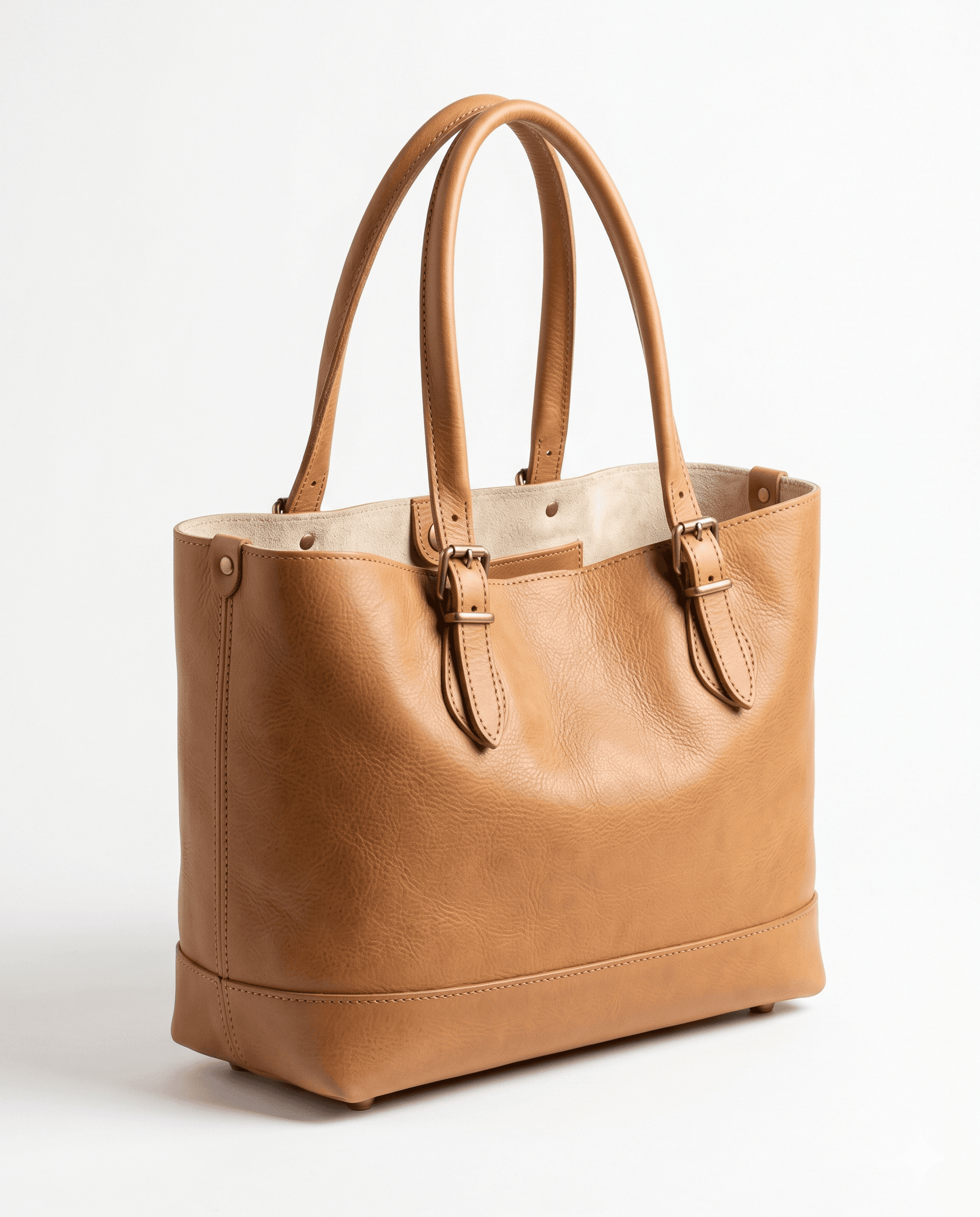
Vegetable-Tanned Leather, Worn
Questions
About Vegetable-Tanned Leather
What is Shantiniketan leather?
Shantiniketan leather is vegetable-tanned, hand-burnished, hand-stitched leather made in the artisan town of Shantiniketan in West Bengal, India. It uses only plant-based tannins (bark and leaf extracts) and is finished entirely by hand.
What is the difference between vegetable-tanned and chrome-tanned leather?
Chrome-tanning uses chromium salts and takes one to two days; the leather remains dimensionally stable and pale. Vegetable-tanning uses plant extracts over weeks or months; the leather is denser, warmer in tone, and develops a patina with use. Vegetable-tanning is significantly more sustainable and produces leather that ages well.
Who makes CETHORA's folios?
Every Cethora Folio is made by Suresh Kumar, a Shantiniketan master leatherworker who has practised the craft for three decades. He works alone. Each folio represents roughly 120 hours of his personal work.